

Description
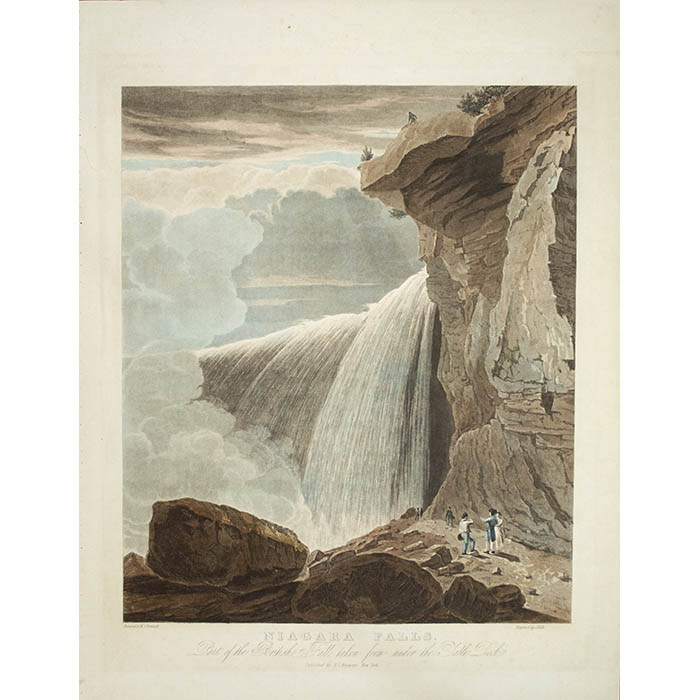
This print is considered by scholars to be among the important American views of the Federal period. It is listed in American Engravers Upon Copper and Steel, and described by Gloria Gilda Deák as follows:
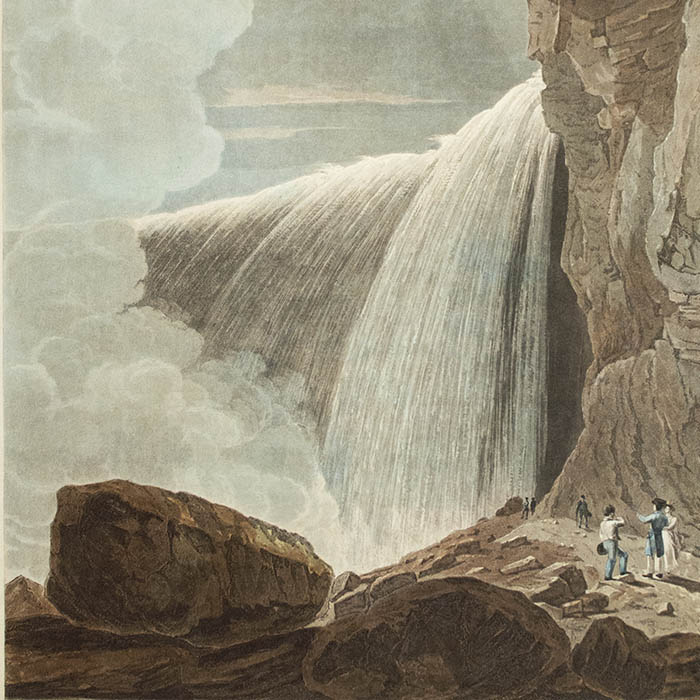
“William Bennett’s depiction of Niagara Falls from under the towering Table Rock is even more dramatic than his companion view from Prospect Point [Item 363]. The splendor of the primeval wilderness that most Europeans associated with the virgin land of America is here forcibly communicated at a range close enough to inspire awe in the viewer. Though figures are included in the scene to project a sense of scale, the pronounced focus is on the ever-changing, nonfigural drama of nature’s primal elements: water, air, sky, clouds, and rocks. Each is presented with an overwhelming power of its own, unified in a radiant composition that underscores the mysterious harmony of the natural world.
Bennett’s original rendering for the aquatint was in the medium of watercolor. He exhibited it at the National Academy of Design in 1829 (the year that marked his full membership in the academy) along with three other of his creations: a view of New York and two landscapes near the Bay of Naples . The Italian views, made abroad while Bennett was still a resident of his native England, came to America with the artist in 1826. Bennett’s application to exhibit the Niagara view is accompanied by the notation that is “One of a series of Views of the Falls, Publishing by H. I. Megarey, Esq.” Bennett made a double set of views of Niagara, which were rendered in aquatint. The dates for the first set were established by Richard J. Koke, whose Checklist provides interesting details regarding the execution of the two aquatints. The aquatints for the second set were issued in 1830. All were published under the imprint of Henry Megarey.”
William James Bennett was born in England and was a member of the Associated Artists in Water-Colours in 1808, exhibiting at the British Water-Colour Society and other London galleries until 1825. He immigrated to New York by 1826, where he worked as a painter of watercolor landscapes and an aquatint engraver. Elected a full member of the American National Academy of Design in the late 1820s, he also served for many years as its curator. A total of 18 views after Bennett were published in the United States as prints. They are considered among the greatest Federal period American views for their quality, accuracy, and beauty. The Princeton University Art Museum has exhibited the complete set, lent from the collection of Leonard L. Milberg, and describes them as follows:
Between 1831 and 1842, the English painter and engraver William James Bennett (1784–1844) produced an informal series of eighteen aquatint views of American cities, ranging from Boston in the North to Mobile, Alabama, on the Gulf of Mexico. Based on originals executed on site by Bennett and other artists, these masterful images present an optimistic vision of a young nation bustling with growth and activity yet simultaneously pristine and ordered—an appealing amalgam of Enlightenment rationality with more dramatic Romantic pictorial effects.
Bennett arrived in America in 1826, steeped in the topographical watercolor tradition established in eighteenth-century England, where increased domestic and foreign travel fostered an appreciation of the scenic world and a demand for images depicting it both accurately and attractively. Aquatint, a form of etching in which the application of powdered rosin allows the creation of tonal areas similar to ink wash, was ideally suited to translate watercolor’s delicate atmospheric effects into the print medium, enabling broad distribution.
As portrayed in Bennett’s aquatints, America’s cities in the 1830s revolved around the coasts and waterways—conduits of trade—on which they were invariably situated, an indication that commerce at this time was still largely a matter of the transportation of goods, with large-scale industry in its infancy. Individually, the prints offer detailed renderings of specific sites significant in the nation’s development; collectively, they compose the finest group of early views of American cities, their expansive, buoyant character serving as a visual metaphor for the country’s future promise.
John Hill (1770-1849) began his career as an aquatint engraver of landscapes in his native London, publishing a series of views after the paintings of J.M.W. Turner and others. He immigrated to the U.S. in 1816 and continued engraving for the next 20 years, first in Philadelphia and later in New York. Hill is well known for his pair of New York City prints New York From Weehawk and the companion view New York from Heights near Brooklyn after views by William Guy Wall (1792-1864). He also did the engravings after views by Wall for the Hudson River Portfolio (1821-1825), a set of 20 hand-colored aquatint views along over 200 miles of the Hudson River, from New York City to the Adirondacks. Published by Henry J. Megarey in New York with text by John Agg, the Hudson River prints are considered amongst the finest produced in 19th-century America. Hill is also renowned for his 20 hand colored aquatint views after paintings by Joshua Shaw published between 1820 and 1821 in what is familiarly called The Landscape Album. His son and grandson, John William Hill and John Henry Hill, also became noted landscape painters.
References:
Deák, Gloria Gilda. Picturing America. Princeton University Press, Princeton, N. J.: 1988, Item 364, p. 246.
Fielding, Mantle. Dictionary of American Painters, Sculptors and Engravers. Green Farms, Connecticut: Modern Books and Crafts, 1926, rev. ed. 1974. (re: Bennett, p. 26; Hill, p. 169).
Groce, George C. and Wallace, David H. The New-York Historical Society’s Dictionary of Artists in America 1564-1860. New Haven: Yale University Press, 1969. (re: Bennett, p. 45; Hill, p. 315).
Koke, Richard, J. A checklist of the American engravings of John Hill (1770-1850). New York: New York Historical Society, 1961. p. 67, no. 136. Online:
https://babel.hathitrust.org/cgi/pt?id=mdp.39015015670485&view=plaintext&seq=67&q1=niagara (13 April 2021).
Kusserow, Karl. “American Prospects: Nineteenth-Century City Views by William James Bennett.” Princeton University Art Museum. 2021. https://artmuseum.princeton.edu/story/american-prospects-nineteenthcentury-city-views-william-james-bennett (13 April 2021).
Redgrave, Samuel. A Dictionary of Artists of the English School: Painters, Sculptors, Architects, Engravers and Ornamentists. London: Longmans, Green, and Col., 1874. (re: Bennett, p. 36).
Stauffer, David McNeely. American Engravers Upon Copper and Steel, Part II. New York: Burt Franklin: 1907. p. 226, no. 1349.