


Description
The following quotation by John Marshall, first Chief Justice of the Supreme Court, appears in the lower right margin of the print: “’….having effected the great object for which he was placed at the head of our armies, we have seen him convert the sword into the ploughshare and sink the soldier in the citizen. (Speech of John Marshall before Congress).”
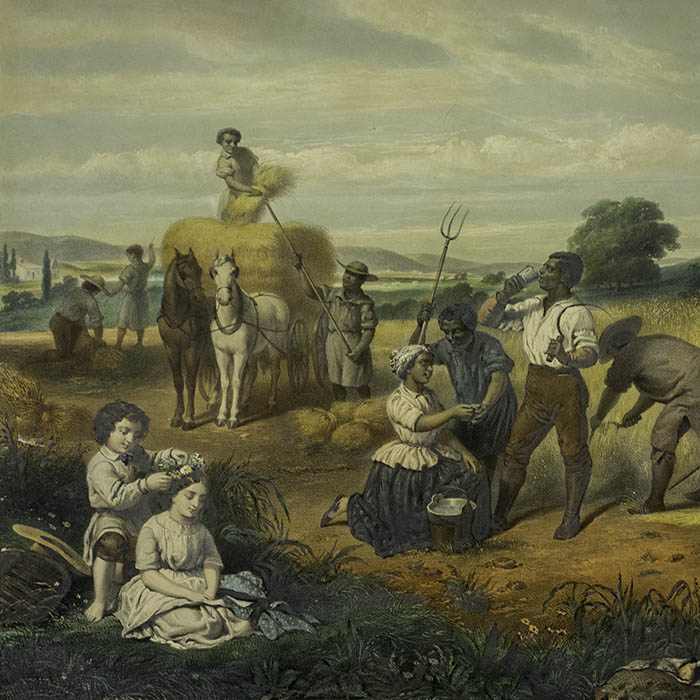
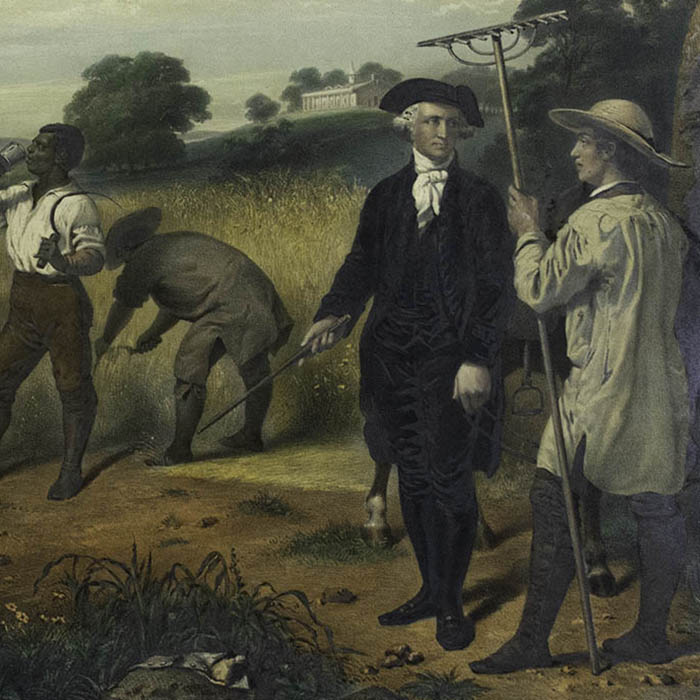
This lithograph is in several important historical collections, including George Washington’s Mount Vernon’s Estate & Gardens, the Virginia Museum of Fine Arts and the Library of Congress. Its historical significance today is in part the depiction of Washington as slaveowner, as well as its context in showing 19th century attitudes toward Washington’s legacy, as described on the Mount Vernon web site:
George Washington left an extraordinary legacy of leadership to the American people. By the middle decades of the nineteenth century, Washington not only was depicted as statesman and soldier but also in domestic roles such as those seen in this engraving: farmer and country gentleman. Having married his “agreeable Consort” Martha Dandridge Custis when he was 26 years old, Washington devoted a lifetime to developing his farms and fisheries. He oversaw all aspects of his plantation, from directing the growing slave community to extensive experimentation with crops and livestock in order to make Mount Vernon a productive and beautiful estate.
Junius Brutus Stearns was an American genre, portrait and history painter. Stearns was born in Arlington, Vermont, and studied at the National Academy of Design around 1838. He exhibited there throughout his career, and by 1850 was a full member, and served as recording secretary from 1851 and 1865. Around 1850, he established himself in New York City and Brooklyn. He is best known for his chronicles of Washington’s life in a series of five mid-19th-century paintings, beginning with Washington and the Indians (1847), which was commissioned by the American Art-Union, an organization that sold works to its members via a lottery. It is now in a private collection. The Marriage of Washington (1849), an oil painting now in the collection of the Butler Institute, was also made into a lithograph. Washington as a Farmer at Mount Vernon (1851) is in the collection of The Mount Vernon’s Ladies Association and was made into the offered print.. Another painting, Washington as Statesman at the Constitutional Convention (1856) is in the collection of the Virginia Museum of Fine Arts. Stearns initially tried to get the American Art-Union to commission his series, but failing to get the commission, undertook the series on his own. From around 1850, Stearns also made a series of genre paintings of fishing scenes, of which 11 are known.
Condition: Generally very good with the usual light overall toning and wear. Scattered minor short tears and chipping to margins, some extending close to or into slightly into the print, professionally restored asrebacked on supporting Japanese paper.
References:
Boehme, Sarah and Hansen, Emma I. “The Feathered Cape and Painted Proof: Stearns painting resolves mystery on unusual feathered capes.” Points West Online. Spring 1997 issue. Buffalo Bill Historical Center web site. http://www.vmfa.state.va.us/collections/50_2_1.html (25 February 2005).
“George Washington, A National Treasure: The Portrait.” Smithsonian National Portrait Gallery. http://www.georgewashington.si.edu/portrait/dress.html (25 February 2005).
“Junius Brutus Stearns.” AskArt.com. http://www.askart.com/biography.asp?ID=21350 (25 February 2005).
“Junius Brutus Stearns, The Marriate of George Washington.” Butler Institute of American Art. http://www.butlerart.com/pc_book/pages/junius.htm (25 February 2005).
“Washington as Statesman at the Constitutional Convention.” Virginia Museum of Fine Arts. http://www.vmfa.state.va.us/collections/50_2_1.html (25 February 2005).
“Works on Paper.” George Washington’s Mount Vernon Estate & Gardens. 2005. http://www.mountvernon.org/learn/collections/index.cfm/sss/25/ (25 February 2005).


