
Description
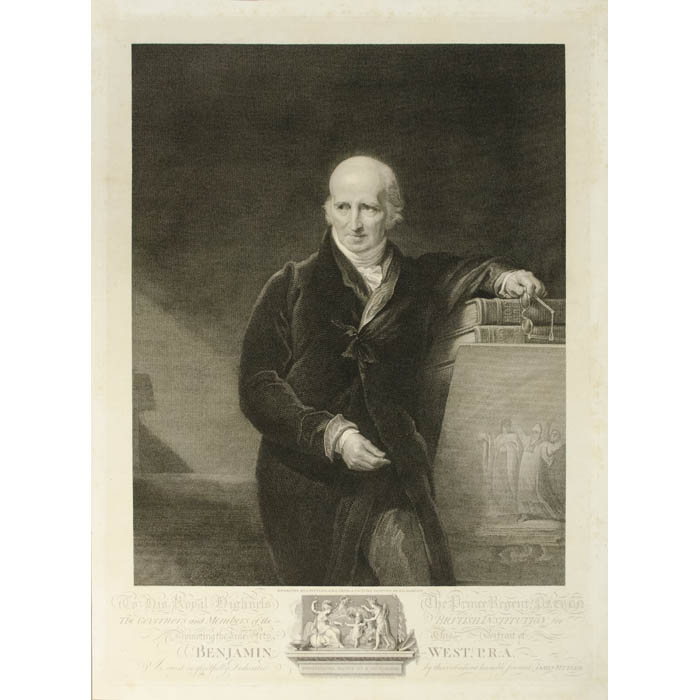
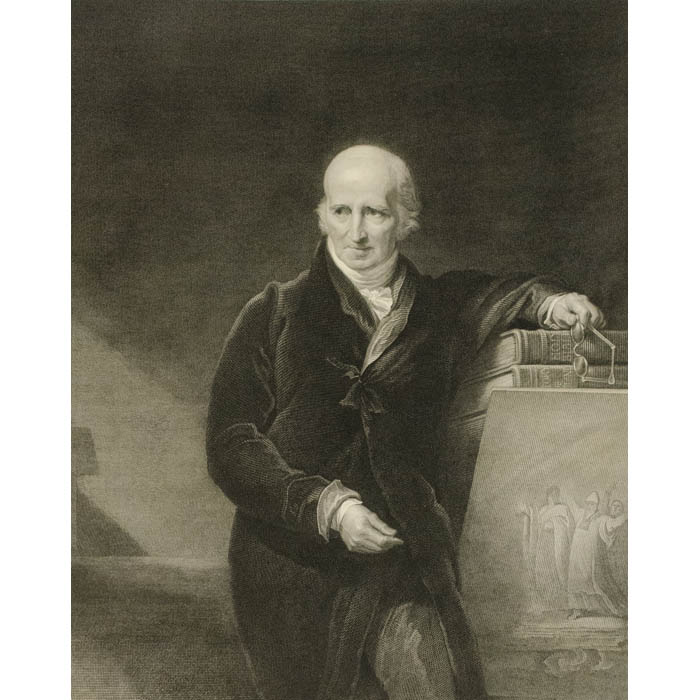
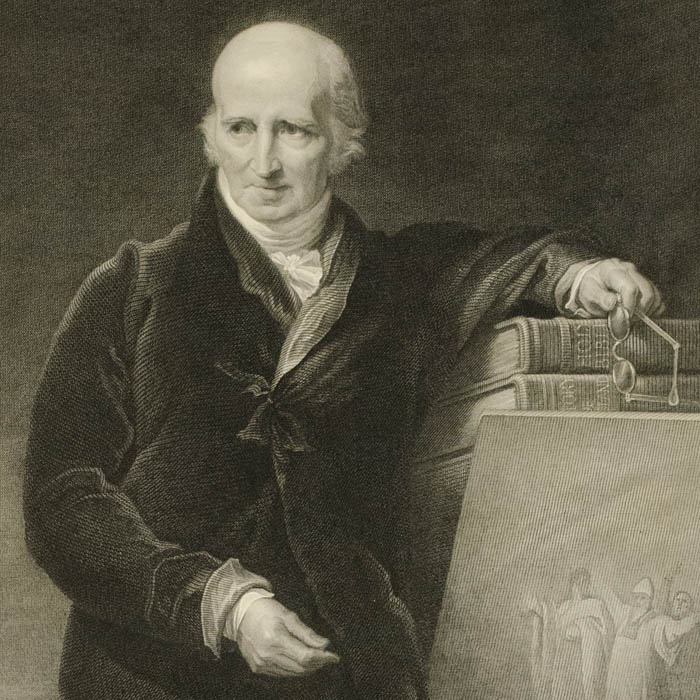
Benjamin West (1738-1820) was an American-born painter of historical and religious subjects as well as portraits, esteemed for his complex compositions and sophisticated glazing techniques. He spent most of his career in London, England, where he became one of the most prominent artists of the late-18th-century, painting some 60 pictures for King George III, and serving as president of the Royal Academy from 1792 until his death in 1820. Born in Pennsylvania, he worked as a portrait painter in eastern Pennsylvania and briefly in New York City before leaving for Italy in 1760 to study for three years, where he transcended the provincial style he had begun with and began incorporating the influences of Renaissance and Baroque artists and his contemporaries. He then moved to London, where he remained for the rest of his long life, never returning to the U.S. although he remained loyal to America. West educated a generation of major American-born artists who traveled to England to study with him before, during, and after the Revolution: Charles Wilson Peale, Gilbert Stuart, John Trumbull, Washington Allston, and Thomas Sully. These artists brought his ideas and techniques to the United States, providing a foundation for the development of American art during the Federal period. Benjamin West’s works today are in the collections of major museums around the world.
George Henry Harlow was a highly successful British portrait painter, working in oils, pencil, chalk and crayon. He trained as a painter under Samuel Drummond and Thomas Lawrence, but rebelled against the mechanical style of the latter and went out on his own. His first commissions were portraits of actors. He debuted at the Royal Academy in 1804 or 1805, and exhibited there regularly for the rest of his life, mostly portraits. In 1815 he began a series of lively portraits of the eminent painters of the day. Many of his works were reproduced as engravings. Harlow died suddenly of illness in 1819, and after his death a collection of about 150 of his works were exhibited.
James Fittler was a British engraver, known for portraits, landscapes, marine subjects, and topographical views, also serving as marine engraver to King George III. Fittler also produced book illustrations, including an Illustrated Bible. He received his training at the Royal Academy Schools in London, and was elected an associate engraver at the Academy in 1800. Fittler produced numerous engravings after other artists, notably Lord Howe’s Victory and Battle of the Nile after Phillippe-Jacques de Loutherbourg.
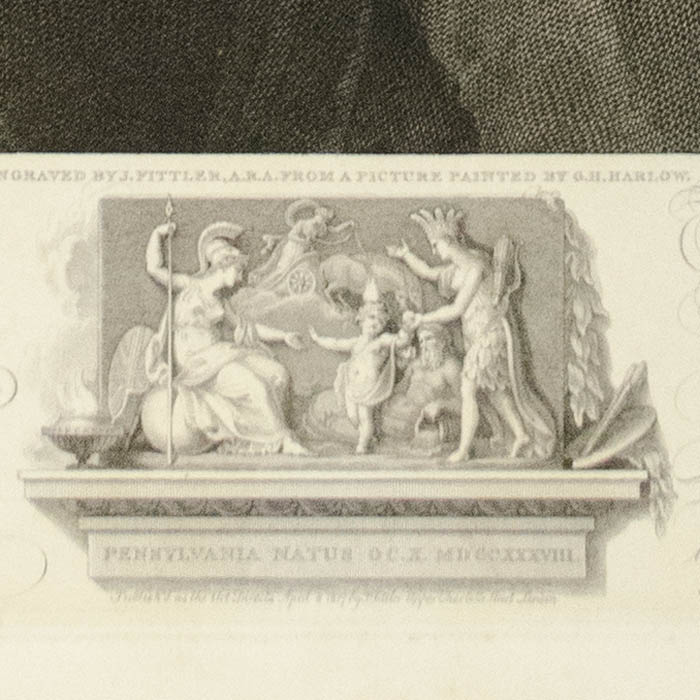
Lettered, lower center: “To His Royal Highness the Prince Regent, Patron. The Governors and Members of the British Institution for Promoting the Fine Arts This Portrait of Benjamin West, P.R.A. Is most respectfully Dedicated by their obedient humble Servant James Fittler.”
Full publication information: Engraved BY J. Fittler, A.R.A from a Picture Painted By G.H. Harlow. Published as the Act Directs, April 8 1817 by J. Fittler Upper Charlotte Street London.
Condition: Generally very good the usual overall light toning, wear, and slight pale occasional foxing.
References:
“Benjamin West.” National Gallery of Art. 2019. https://www.nga.gov/collection/artist-info.1970.html (27 June 2019).
“George Henry Harlow.” National Portrait Gallery. https://www.npg.org.uk/collections/search/person/mp02051/george-henry-harlow (27 June 2019).
Redgrave, Samuel. A Dictionary of Artists of the English School: Painters, Sculptors, Architects, Engravers and Ornamentists. London: Longmans, Green, and Col., 1874. pp. 148, 190-191.
“Sale 1186. Lot 386.” Christie’s. https://www.christies.com/lotfinder/Lot/george-henry-harlow-pra-london-1787-1819-5714944-details.aspx (27 June 2019).


