
![Bacco, Plate 28 [Bacchus] (Dolcibene/Bossi)](https://staging.georgeglazer.com/wp-content/uploads/2020/07/pio-clementino-plate28.jpg)
![Mitra, Figura Simbolica, Plate 19 [Mitra, Symbolic Figure] (Dolcibene/Pozzi)](https://staging.georgeglazer.com/wp-content/uploads/2020/07/pio-clementino-plate19.jpg)
![Venere Vincitrice, Trovata negli scavi d'Otricoli, Plate 22 [Venus Victorious, found in the excavations of Otricoli] (Dolcibene/Perini)](https://staging.georgeglazer.com/wp-content/uploads/2020/07/pio-clementino-plate22.jpg)
![Melpomene, Statua Colossale giá nel Cortile della Cancellaria, Plate 26 [Melpomene, Colossal Statue already in the Courtyard of the Chancellery] (Matteini/Carattoni)](https://staging.georgeglazer.com/wp-content/uploads/2020/07/pio-clementino-plate26.jpg)
![Adone, Giá conosciuto sotto il nome di Narciso nel Palazzo Barberini, Plate 31 [Adonis, Already known by the name as Narcissus in the Barberini Palace] (Matteini/Muchetti)](https://staging.georgeglazer.com/wp-content/uploads/2020/07/pio-clementino-plate31.jpg)
![Adone, Plate 32 [Adonis] (Matteini/Bossi)](https://staging.georgeglazer.com/wp-content/uploads/2020/07/pio-clementino-plate32.jpg)
![Meleagro, Giá nel Palazzo Pighini, Plate 34 [Meleager, Already in the Palazzo Pighini] (Pacetti/Bossi)](https://staging.georgeglazer.com/wp-content/uploads/2020/07/pio-clementino-plate34.jpg)
![Ganimede, Plate 35 [Ganymede] (Dolcibene/Muchetti)](https://staging.georgeglazer.com/wp-content/uploads/2020/07/pio-clementino-plate35.jpg)
![Ganimede, Col Berretto Frigio, Plate 36 [Ganymede, with the Phrygian Cap] (Matteini/Tinti)](https://staging.georgeglazer.com/wp-content/uploads/2020/07/pio-clementino-plate36.jpg)
![Amazone, Giá nella Villa Mattei, Plate 38 [Amazon, Already in the Villa Mattei] (Dolcibene/Tinti)](https://staging.georgeglazer.com/wp-content/uploads/2020/07/pio-clementino-plate38.jpg)
![Laocoonte, Plate 39 [Laocoön] (Matteini/Muchetti)](https://staging.georgeglazer.com/wp-content/uploads/2020/07/pio-clementino-plate39.jpg)
Description
Interest in classical antiquities in the Age of Enlightenment in the early 18th century led the way to the important neoclassical period in art history that persisted until the Victorian era (and in some form has always been present in western art in from the decline of the Roman Empire to present). In the essay “Neoclassicism,” the Metropolitan Museum of Art describes this period, including the creation of the Museo Pio-Clementino to preserve and maintain ancient Greek and Roman sculptures within Italy:
Travelers were also important students of Roman and Greek antiquity. In the early eighteenth century, painted visions of Greco-Roman monuments already could be found in continental palaces and English country homes. Soon, persons of culture and sensibility known to the Italians as cognoscenti were descending upon the peninsula to embark on the Grand Tour. In Rome, …[t]ourists prized not only souvenir portraits of themselves by painters … but also the exquisite ancient objects they encountered. Faced with the threat of the catastrophic dispersal of this legacy, the popes intervened. Cardinal Alessandro Albani’s collection of antique marbles was acquired by Clement XII in 1733, despite lucrative offers from abroad. Whereas over the two previous centuries the reigning pope would have bought such treasures for himself and his family, they were purchased for the city of Rome itself and placed in one of the palaces on the Capitoline that Michelangelo had designed. Since excavations were continually disgorging more objects, Clement XIV inaugurated a great museum in the Vatican in 1769, energetically enriched by his successor Pius VI. The Museo Pio-Clementino represents the height of papal patronage of the arts in Rome.
Among the prints from this series that we may have in stock are the following, listed with artist and engraver:
Mitra, Figura Simbolica, Plate 19 [Mitra, Symbolic Figure] (Dolcibene/Pozzi)
Venere Vincitrice, Trovata negli scavi d’Otricoli, Plate 22 [Venus Victorious, found in the excavations of Otricoli] (Dolcibene/Perini)
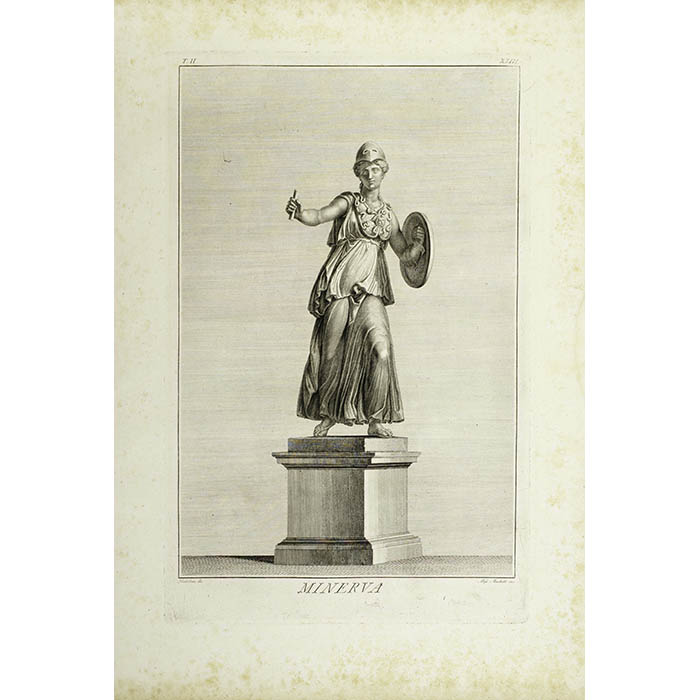
Minerva, Plate 23 (Dolcibene/Muchetti)
Melpomene, Statua Colossale giá nel Cortile della Cancellaria, Plate 26 [Melpomene, Colossal Statue already in the Courtyard of the Chancellery] (Matteini/Carattoni)
Bacco, Plate 28 [Bacchus] (Dolcibene/Bossi)
Adone, Giá conosciuto sotto il nome di Narciso nel Palazzo Barberini, Plate 31 [Adonis, Already known by the name as Narcissus in the Barberini Palace] (Matteini/Muchetti)
Adone, Plate 32 [Adonis] (Matteini/Bossi)
Meleagro, Giá nel Palazzo Pighini, Plate 34 [Meleager, Already in the Palazzo Pighini] (Pacetti/Bossi)
Ganimede, Plate 35 [Ganymede] (Dolcibene/Muchetti)
Ganimede, Col Berretto Frigio, Plate 36 [Ganymede, with the Phrygian Cap] (Matteini/Tinti)
Amazone, Giá nella Villa Mattei, Plate 38 [Amazon, Already in the Villa Mattei] (Dolcibene/Tinti)
Laocoonte, Plate 39 [Laocoön] (Matteini/Muchetti)
Full title and dedication for volume 2: Il Museo Pio-Clementino, Descritto da Ennio Quirino Visconti, Tomo Secondo, Dedicato Alla Santita di Nostro Signore Pio Sesto, Pontefice Massimo, Da Ludovico Mirri, In Roma MDCCLXXXIV Con Privilegio Pontifico [The Museum Pio-Clementino, Described by Ennio Quirino Visconti, Second Volume, Dedicated to the Holiness of Our Lord Pius the Sixth, Pontiff Maximus, By Ludovico Mirri, In Rome 1784 With Pontifical Privilege]
Condition: Each generally very good with the usual light overall toning and wear. Marginal damp staining and occasional light scattered foxing in outer margin on some prints; can be matted out when framing.
Reference:
“Neoclassicism.” Metropolitan Museum of Art. 2000-2020. https://www.metmuseum.org/toah/hd/neoc_1/hd_neoc_1.htm (22 July 2020).


