


Description
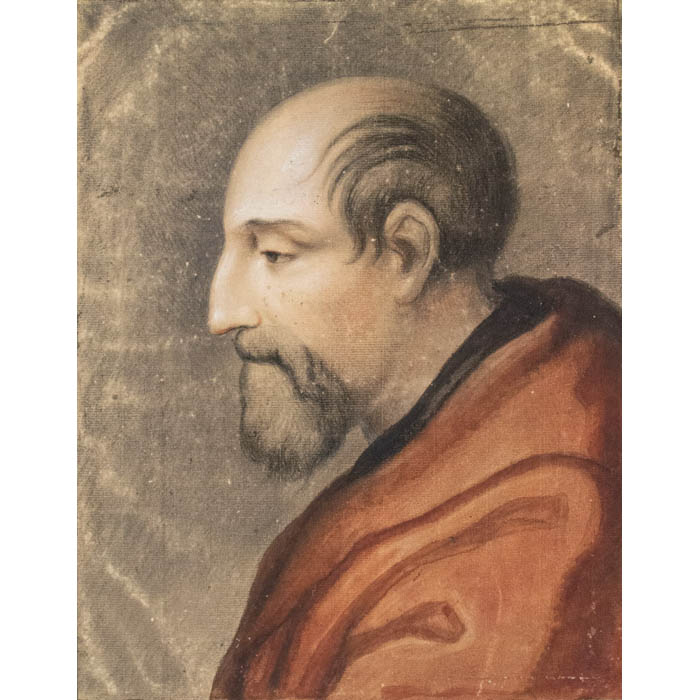
Portrait of Correggio: Portrait of the Italian Renaissance painter Antonio Allegri da Correggio (1489-1534). Tischbein’s source for this drawing appears to be based on a late-17th-century engraving by Milanese printmaker Giovanni Francesco Bugatti designed by Ambrogio Besozzi (1648-1706), possibly after a composition by Annibale Carracci. It depicts the bearded artist in profile in a heavy robe or cloak, his thinning hair combed forward over his ear. Correggio spent most of his life in Parma. He completed many major commissions for both private buildings and churches, including the domes of San Giovanni Evangelista and the the Cathedral of Parma, whose dramatic and innovative illusionistic designs would influence later artists of the Mannerist, Baroque and Rococo eras. He is also known for a suite of sensual mythological paintings depicting the Loves of Jupiter that were commissioned by Federico II Gonzaga, all of which are now in major European museums.
Portrait of Michelangelo: Portrait of the renowned Italian Renaissance painter, sculptor, architect and poet Michelangelo Buonarotti (1475-1564). Tischbein based it on a famous unfinished portrait attributed to Daniele da Volterra (c. 1509-1566) that was probably painted around 1545 and was the source for numerous copies by many artists over the following centuries. The original painting is in the collection of the Metropolitan Museum of Art. Michelangelo is a seminal figure in the development of Western art, celebrated in his own time as the greatest living artist, and has remained an influential and revered figure by painters and sculptors alike. His varied accomplishments over a long and productive life exemplified the ideal of the “Renaissance man.” His masterpieces include the frescos decorating the Vatican’s Sistine Chapel, his marble statue of David for the cathedral of Florence, and Florence’s Medici Chapel.
Portrait of Raphael: Portrait of the Italian Renaissance painter Raphael Sanzio d’Urbino (1483-1520). Tischbein’s source for this drawing is unknown, but it appears to be based on a self-portrait that Raphael included in his monumental fresco painting, The School of Athens (1509-11). Tischbein’s rendering portrays a youthful Raphael with blond hair, wearing a dark cap. The face and hair are rendered in color, while the clothing and background are brown and gray. Raphael was one of the three greatest artists of the Italian High Renaissance and an accomplished architect as well. As chief archeologist to the Pope, he was involved in the excavation of the ancient Golden House of Nero, and adapted many of the elaborate Roman frescoes he saw there in creating his own innovative painted wall and ceiling designs in the Vatican and private villas in Rome. Prints made after Raphael’s drawings, designs and paintings were produced during his lifetime by the engraver Marcantonio Raimondi (c.1470-1482 – c. 1527-1534). Raphael prints by other engravers were especially popular in the neoclassical period of the mid 18th century and early 19th century coinciding with the tremendous revival of interest in the classical art of ancient Greece and Rome, as well as the classicism of the Renaissance. Some of these prints served as references for architects and designers because many were based on frescoes that had been incorporated into interior architecture. This interest in Raphael, often reflected in prints, continued throughout the 19th century as he achieved legendary status.
Portrait of a Young Man after Bordone: Study after an oil painting that has variously been attributed to different artists during the 19th century and most of the 20th (Giorgione, Romanino, or Licinio), but the scholarly consensus from the late 1980s to the present is that it was painted by Paris Bordone (1500-1571). The painting is now in the collection of the Ringling Museum of Art in Sarasota, Florida, where it is still listed online as attributed to Girolamo Romanino (as listed in a 1959 reference work). However, it is attributed to Bordone in Andrea Donati’s 2014 catalogue raisonné of Bordone’s work, with the title Portrait of a Young Man with Beard and Striped Jacket. After early training by Titian, he established himself as a painter, based in Venice for most of his life, gradually incorporating Mannerist influences into his style.
Portrait of a Harpsichord Player after Titian: Study after the central figure, a harpsichord player, in The Concert (1510-11) by Titian (c. 1488-1576), a famous painting in the Palatine Gallery of the Pitti Palace in Florence. According to the Uffizi Gallery website, art historians are uncertain if the three musicians in the painting depict actual historical figures or were Titian’s invention. Titian (Tiziano Vecellio) was one of the great Italian painters, draftsmen and printmakers of the late Renaissance, considered the foremost painter of the Venetian school. His painterly technique, characterized by looser brushwork, less defined outlines and mutually related colors, influenced later generations of artists. Titian painted religious, historical and mythological subjects, portraits and allegories.
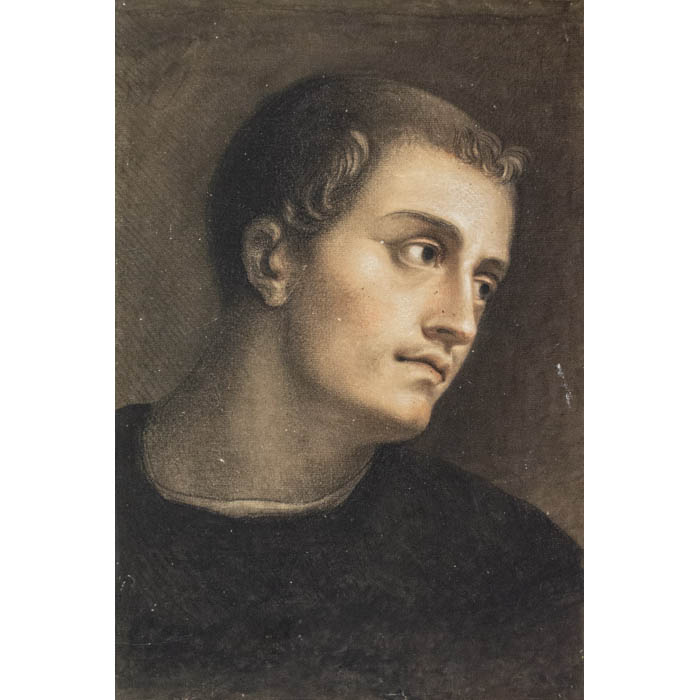
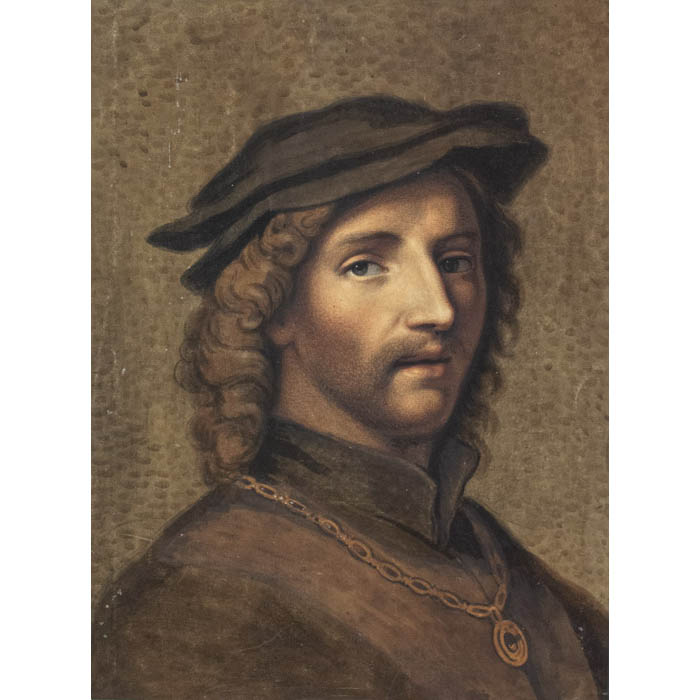
[Portrait of a Man after a Renaissance Artist]: Study of a young man with shoulder-length curly hair, wearing a black cap and a medallion on a chain around his neck. Thus far, we have been unable to find the exact source of this portrait. If you know please email us!
Johann Heinrich Wilhelm Tischbein was a German painter, engraver and theorist, a leading advocate and practitioner of the Neoclassical style. He was part of a family that produced 28 artists in the 18th and 19th centuries, including his uncle, Johann Heinrich Tischbein I, who gave him his initial art training in the late Baroque style popular at the time. In 1776, he went to Hamburg, where he studied with his relative Johann Jakob Tischbein. During the 1770s, he also traveled to the Netherlands and other European cities to study the old masters. From 1777 to 1779 he worked as a portrait painter to the Prussian court in Berlin. He spent the following two years in Italy, mainly studying under the Swiss sculptor Alexander Trippel in Rome, from whom he learned the principles of Neoclassicism. In 1787, he accompanied the author Goethe to Naples, painting a well-known portrait that earned him the nickname “the Goethe Tischbein” to distinguish him from his other artistic relatives. Two years later, Tischbein became director of the academy in Naples. While living there, he met the antiquary and British envoy Sir William Hamilton, and painted a portrait of Hamilton’s wife as well as making an influential series of folio-size engravings of Greek vases in Hamilton’s collection, published in Florence, 1801-08. Tischbein also made 81 etchings illustrating Homer. When the French occupied Naples, he returned to Germany, spending the last 21 years of his life at Eutin.
Condition: Each generally very good with the usual overall light toning, wear, handling. There are old pencil inscriptions in the lower margins of these drawings, some of which misidentify the artist whose work is represented.
References:
“Antonia da Correggio.” Wikipedia. 2 September 2022. https://en.wikipedia.org/wiki/Antonio_da_Correggio (7 September 2022).
Donati, Andrea. Paris Bordone Catalogo Ragionato. Soncino, Italy: Edizioni del Soncino, 2014. 186.
Gilbert, Creighton E. “Michelangelo.” Britannica. 24 August 2002. https://www.britannica.com/biography/Michelangelo (7 September 2022).
“Ideal Portrait of Correggio.” Inventory-Catalog of the Drawings in the Biblioteca Ambrosiana. 14 August 2014. (7 September 2022).
“Michelangelo Buonarroti.” Metropolitan Museum of Art. 2000-2022. https://www.metmuseum.org/art/collection/search/436771 (7 September 2022).
“Portrait of a Young Man.” The Ringling. https://emuseum.ringling.org/emuseum/objects/26999/portrait-of-a-young-man?ctx=73b47a55-8f45-42bc-b7b0-ec6af3892418&idx=124 (12 September 2022).
“The Concert.” Le Gallerie degli Uffizi. https://www.uffizi.it/en/artworks/titian-the-concert?fbclid=IwAR3EARVALejM4ynC3ihsmt3e5yZwvjq1V1Iasire7daG-eGp2vpTmb0DQiA (12 September 2022).
“The School of Athens.” Wikipedia. 7 August 2022. https://en.wikipedia.org/wiki/The_School_of_Athens (26 August 2022).
“Tischbein.” The Grove Dictionary of Art. New York: Macmillan. 2000. Artnet.com. http://www.artnet.com/library/08/0852/T085218.asp (4 January 2006).
Williamson, George C., ed. Bryan’s Dictionary of Painters and Engravers. London: G. Bell and Sons, 1930. Vol. 5, pp. 184-185 (Tischbein).